
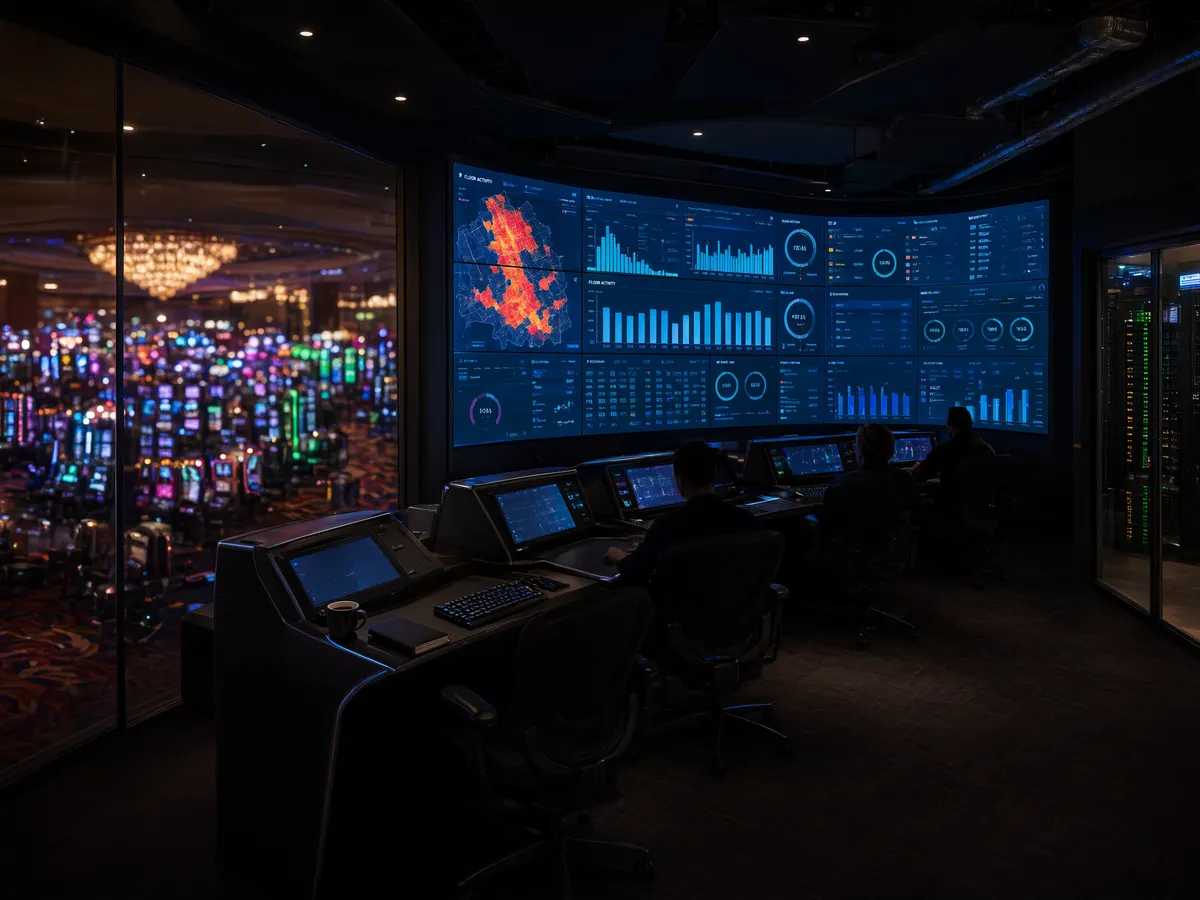
Picture the walk between two demo screens at The Venetian Expo. On the first, a slot floor heat map updates while you watch. On the second, the same property’s restaurant covers, hotel occupancy and a host’s task list. The pitch at that moment is simple: these should not be two screens.
That was the thread running through Quick Custom Intelligence’s appearance at Global Gaming Expo 2026, held September 28 to October 1 in Las Vegas, where the company put its vision for unified resort operations in front of the industry’s biggest annual crowd. Alongside live demonstrations, QCI ran a branded RV activation and expanded what its QCI Metrics product can do, with QCI Resorts positioned as the centrepiece. The company’s Dr. Ralph Thomas and Andrew Cardno fronted the conversations.
What unified resort operations actually means
Unified resort operations is the model where hospitality, food and beverage, marketing, loyalty, guest engagement and enterprise operations run inside one shared operational environment, with gaming systems integrated where they need to be, rather than each department working from its own disconnected software. The point is that every team reads the same numbers at the same time and can act on them without waiting for a report.
That is a meaningfully different claim from the usual “single pane of glass” line. A dashboard that pulls yesterday’s data from six places is still six systems with a window painted on top. A unified platform means the host, the F&B manager and the slot performance analyst are looking at one version of the guest and one version of the day.
Why this is landing now: casinos have spent two decades buying best-of-breed point solutions. A separate casino management platform for the floor, a property management system for rooms, a POS for outlets, a CRM for campaigns, player loyalty systems bolted across the lot, plus whatever spreadsheet the marketing team actually trusts. Each one works. The seams between them are where money and guest goodwill quietly leak out.
Start by mapping where your data really lives
Before you look at any gaming operations software, do the boring audit. List every system that holds a fact about a guest or a revenue event, then write down who owns it, how often it refreshes, and who has to ask permission to see it.
Most operators find three unpleasant things. First, the same guest exists under two or three identities. Second, “real time” in practice means overnight batch. Third, at least one critical decision depends on a file someone emails round on Monday mornings.
You cannot evaluate unification until you know how fragmented you are. This audit also gives you the only honest baseline you will ever get for measuring whether a new platform helped.
Decide what each team genuinely needs in real time
Not everything has to be instant, and vendors will happily sell you latency you do not need. Sort your decisions into three buckets: this minute, this shift, this month.
- This minute: a high-value guest walks past a host desk; a bank of machines goes dead; a restaurant waitlist hits 40 minutes while the floor is full.
- This shift: staffing against actual coin-in, comp decisions, table opens and closes.
- This month: game mix on the floor, campaign performance, capital planning.
Real-time intelligence earns its cost in the first bucket, helps in the second, and is largely irrelevant in the third. Price your requirements accordingly.
Work out which systems have to agree with each other
The clearest way to see the value of unification is to take ordinary operational questions and count how many systems must line up to answer them properly.
| The question on the floor | Systems that have to agree | What goes wrong when they don’t |
|---|---|---|
| Is this guest worth a comp right now? | Slot accounting, table ratings, loyalty tier, hotel folio, POS spend | Hosts comp on gaming theo alone and ignore what the guest spends across the property |
| Which machines should move, and where? | Casino floor technology data, play by position, guest segment, cabinet maintenance logs | Game mix decisions made on performance averages that hide who actually plays what |
| Did that offer work? | Campaign records, redemption data, trip-level play, room and F&B revenue | Reinvestment is credited to the last touch, so the wrong campaigns get renewed |
| Is this guest on a self-exclusion list? | Loyalty, cage, hotel, player protection records across every property | An excluded person is served, which is a regulatory problem and a human one |
| Does this cash activity need reporting? | Cage, slot, table, patron identity records in one gaming day | Aggregation is missed and compliance filings are built on partial data |
That last row is where unification stops being a convenience and becomes an obligation. US casinos have to report cash transactions above the regulatory threshold within a single gaming day, and aggregation only works if the cage, the pit and the slot system are counting the same patron. Stitching that together after the fact is expensive and error prone. Having it land in one place is the argument for consolidated architecture in a sentence.
Treat loyalty as one ledger
If you take one practical idea from the unified model, make it this one. A guest does not experience your loyalty programme as a gaming scheme with hotel and restaurant extensions. They experience it as a relationship with the property.
So check whether your player loyalty systems can hold non-gaming value properly: tier credits from a steakhouse, a spa booking, a show ticket, a room night paid in cash. If F&B spend is invisible to the host and gaming theo is invisible to the restaurant manager, you are making reinvestment decisions on a fraction of the picture, and the guest can tell.
Gaming revenue still anchors most casino resort models, which is exactly why the non-gaming signals deserve equal weight in the data. They are the part nobody else can see.
Pressure-test the demo, not the deck
Trade show demos are built to look effortless. Yours will not be. When you get a vendor in front of you, whether at G2E or on a video call three months later, push on the unglamorous parts:
- Ask what “integrated” means in your specific stack. Native, certified connector, or a project? Name the systems out loud and get the answer on paper.
- Ask how one guest becomes one record. Identity resolution across gaming, hotel and POS is the hardest part of any casino management platform. Make them show the merge rules and what happens to conflicts.
- Ask what a floor manager sees on a phone at 11pm. Platforms live or die on frontline adoption, not on the executive dashboard.
- Ask about data ownership and export. If you leave in five years, what comes with you and in what format?
- Ask for a reference you choose. Ideally a property of similar size and a similar regulatory environment, not the flagship client everyone gets shown.
Pilot narrow, measure honestly
Do not unify everything at once. Pick one decision that currently requires three systems and a phone call, and move only that into the new environment. Host task management is a good candidate. So is the daily game performance review.
Then measure against the baseline from your audit: time to answer the question, number of people involved, how often the answer changed a decision. Those are unglamorous metrics, and they are the ones that survive a budget review. Revenue attribution claims in year one rarely do.
One more thing worth building in while the architecture is still open. The same joined-up data that sharpens marketing also makes player protection work better: cross-property exclusion that actually holds, limits that follow the guest, and flags that a host sees before a problem grows. Operators who design responsible gambling tools into the platform at the start spend far less on retrofitting them when a regulator asks.
Where this is heading
QCI’s G2E 2026 run is one supplier making its case, but the direction of travel is broader than one booth. Consolidated casino technology is moving from an IT preference to an operating assumption, driven as much by compliance reporting and labour pressure as by guest personalisation.
The practical takeaway for an operator is less about choosing a vendor this quarter and more about not making the next purchase worse. Every new system you buy either joins the shared environment or becomes another seam. Ask that question before you sign, and the unified version of your operation gets cheaper every year instead of more expensive.