Every September, equity analysts walk the supplier halls at the Global Gaming Expo in Las Vegas, press a few demo buttons, and go home to rewrite their spreadsheets. One of them came back more convinced about Light & Wonder. Jefferies Equity Research analyst Kai Erman told clients he “recently came away more convicted” on the slotmaker after G2E, and the case for renewed Light & Wonder stock momentum rests almost entirely on cabinets and content rather than on the quarter the company is about to report.
That distinction matters more than the headline does. The bullish read on Light & Wonder is defensible. The reason usually given for it, that the business is accelerating right now, is not what the note actually says.
What the Jefferies note actually says
Erman took a wait-and-see position ahead of third-quarter management commentary, while telling clients his conviction on the product portfolio had improved after the show. Reported coverage of the note describes no rating change or price target move, and Erman himself called his estimate revisions “minimal.”
Those revisions went in both directions. He trimmed his third-quarter cash flow number slightly below the street while nudging earnings per share slightly above it.
| Third-quarter estimate | Erman (Jefferies) | Market consensus |
|---|---|---|
| Cash flow | AU$382 million | AU$386 million |
| Earnings per share | AU$1.97 | AU$1.92 |
The Australian dollar denominations reflect the fact that Light & Wonder now holds a sole listing on the Australian Securities Exchange, having delisted from Nasdaq effective November 13, 2025, and Jefferies covers it from that side of the ledger. Either way, a four million dollar gap on cash flow and five cents on EPS is noise, not a thesis. The thesis sits in what he expects the product cycle to do from the fourth quarter onward.
What he credits for the conviction
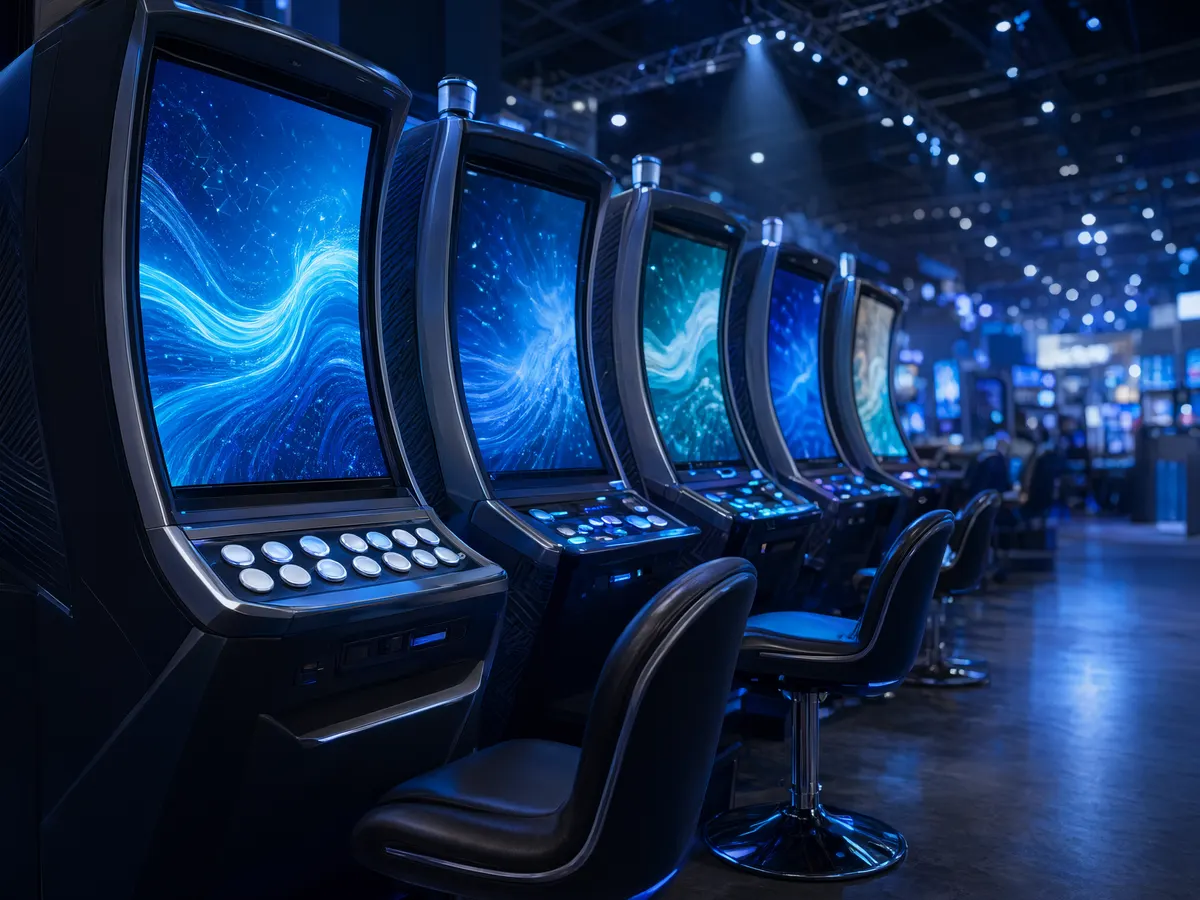
Three things, named in the note. The pace of Lightwave Solar cabinet sales in the United States, which pushed Erman to raise both his US and international sales expectations. Confidence in the Cosmic Dual cabinet, built on how the Rolling Drums and Big Steam games have performed in Australia. And the depth of the product range he saw at G2E, which he said bolstered his view of how much Light & Wonder has in the pipeline.
Then comes the qualifier that most summaries drop: he said that depth would be unlikely to show up in third-quarter performance. The content is real. The timing is later.
What Light & Wonder actually sells
Light & Wonder is a cross-platform gaming supplier built around three reported segments: Gaming, which covers land-based slot machines, leased gaming operations units, table products and casino systems; SciPlay, its social and mobile casino games business; and iGaming, which licenses and distributes slot content to online operators. It also recently added charitable gaming specialist Grover Gaming, a detail that becomes important in a moment.
So when an analyst talks about momentum at this company, he is talking about cabinets shipping to casino floors, leased premium machines earning a daily fee, and the same game mathematics being re-skinned for mobile and online lobbies. Content is the product and the distribution is the moat.
The gap between the momentum and the quarter
Excluding Grover’s charitable gaming units, Light & Wonder’s gaming revenue grew 3 percent in the first quarter of 2026. That single line explains a good deal about how the stock has traded. Erman’s own read on recent share price weakness was that the market “is questioning [either] consensus earnings or their quality.”
Which is the honest version of the bull case. You are not being told the company is compounding quickly today. You are being told that an acceleration in revenue would be the catalyst, and that the product portfolio on display in Las Vegas makes that acceleration more plausible than it looked six months ago. For the fourth quarter he expects stronger operating metrics, supported by seasonality, share gains and what he called improving content momentum, with the company itself guiding to sequential increases in slot machine sales and mid-single-digit growth in Gaming Operations.
Cabinets, SciPlay or the balance sheet: which leg is load-bearing
Weigh the three drivers against each other and the ranking is not close.
The cabinet and content cycle is the strong leg. For 2027 Erman modelled premium machine installations of roughly 500 per quarter, with revenue gains driven by slot sell-through in the US at 25 to 29 percent of that market, plus Cosmic Dual traction in Australia and New Zealand. He put potential cash flow growth at as much as nine percent, with roughly five percent revenue improvement in 2027.
SciPlay is the weak leg, and he said so by cutting his estimates. His SciPlay revenue growth forecasts sit below consensus, offset by a lower-revenue, higher-margin mix assumption. If you were hoping the digital social business would carry the story, it is doing the opposite.
The balance sheet is the quiet one. Debt reduction, Erman wrote, is the near-term corporate priority, and buybacks look off the table until leverage falls to 2.5 times cash flow from a current level he put at or near 3.2 times. He admitted to limited visibility there. So the equity case runs through deleveraging and delivery against guidance rather than through capital returns.
Verdict: the bullish call holds up, but on a 2027 product and deleveraging argument, not on current trading. Anyone repeating it as “the business is already turning” has the right conclusion and the wrong reason.
Where Light & Wonder sits among gaming technology companies
Light & Wonder is now one of a shrinking set of listed, content-led suppliers. Aristocrat Leisure remains the comparison that matters most, both because of its scale in land-based slots and because the Sydney-headquartered manufacturer competes on home ground in Australia, the market where Erman expects Cosmic Dual to gain traction. Meanwhile the IGT gaming business and Everi have moved under private equity ownership through the Apollo transaction, which removes a chunk of comparable public disclosure from the sector.
That scarcity cuts both ways for industry watchers. Fewer listed suppliers means fewer windows into how fast cabinets are actually selling, so notes like this one carry more weight than they probably should.
What operators and players would notice
If the forecast holds, the visible result is more new cabinet hardware on floors, more premium leased units of the type that earn a daily fee, and continued porting of the same game brands into online and social lobbies. For operators, cabinet competition tends to show up as better lease terms and faster refresh cycles. For players, it shows up as new titles in the bank by the cage and new slots appearing in online lobbies.
None of that changes the mathematics. A new cabinet is a new presentation of the same return to player percentage and the same house edge, and a game with a richer bonus structure is not a game with better odds. Treat new releases as entertainment with a built-in cost, set deposit and time limits before you play, and use operator self-exclusion tools if play stops feeling like a choice.
One note, one analyst, one quarter still unreported
This is a single analyst’s opinion published by one firm and reported by CDC Gaming, not a consensus view and not investment advice. Estimates move, trade show enthusiasm does not always convert into shipments, and the note’s own framing was wait-and-see rather than full-throated.
What is genuinely unresolved is the thing Erman himself was waiting for: management’s commentary on the third quarter, and whether gaming revenue growth excluding Grover accelerates beyond that 3 percent pace. Until that lands, the momentum case is a forecast about 2027 wearing the clothes of a current-quarter story.