A Nevada Gaming Control Board agenda item on a Wednesday morning is not where you expect candour. Konami Gaming was there for its tenth shelf registration renewal, a piece of paperwork so unremarkable that board chairman Mike Dreitzer called the application routine before anyone had finished sitting down. Then he asked Thomas Jingoli, Konami’s president and COO, for his read on the state’s market, and Jingoli described it as probably the most competitive gaming market in the world.
Coming from a supplier that has been licensed in Nevada for decades, that is not a throwaway line. It is also, in various ways, widely misunderstood. The Nevada gaming market gets described as mature, saturated, a formality for any manufacturer with a Macau or tribal business to fall back on. The hearing transcript suggests something more awkward and more interesting.
The myth that a shelf renewal is just paperwork
Konami qualifies for continuous or delayed public offerings under Nevada’s Regulation 16.115 because it is a publicly traded corporation registered with the Nevada Gaming Commission and listed on the Tokyo and London stock exchanges. Shelf registration lets a registered company raise capital without returning to regulators for each offering. Dreitzer asked the obvious question: had Konami ever actually used it?
“We have not,” Jingoli said. A few deals over the years had come close and then didn’t materialise. The company keeps the authorisation live anyway, because the moment it lapses, something will come up and the whole process starts again.
Ten renewals of a facility never once drawn down tells you what Nevada licensing really costs a supplier: not money, but permanent readiness. Gaming machine competition is won on timing, and a manufacturer that has to go ask permission before it can finance an acquisition or a big floor placement is a manufacturer that loses the deal. The paperwork is the cheap part of staying credible in Nevada’s regulatory system.
The myth that Nevada means the Strip
This is the one that distorts almost every conversation about Las Vegas slots. Jingoli broke the state into pieces that behave nothing alike.
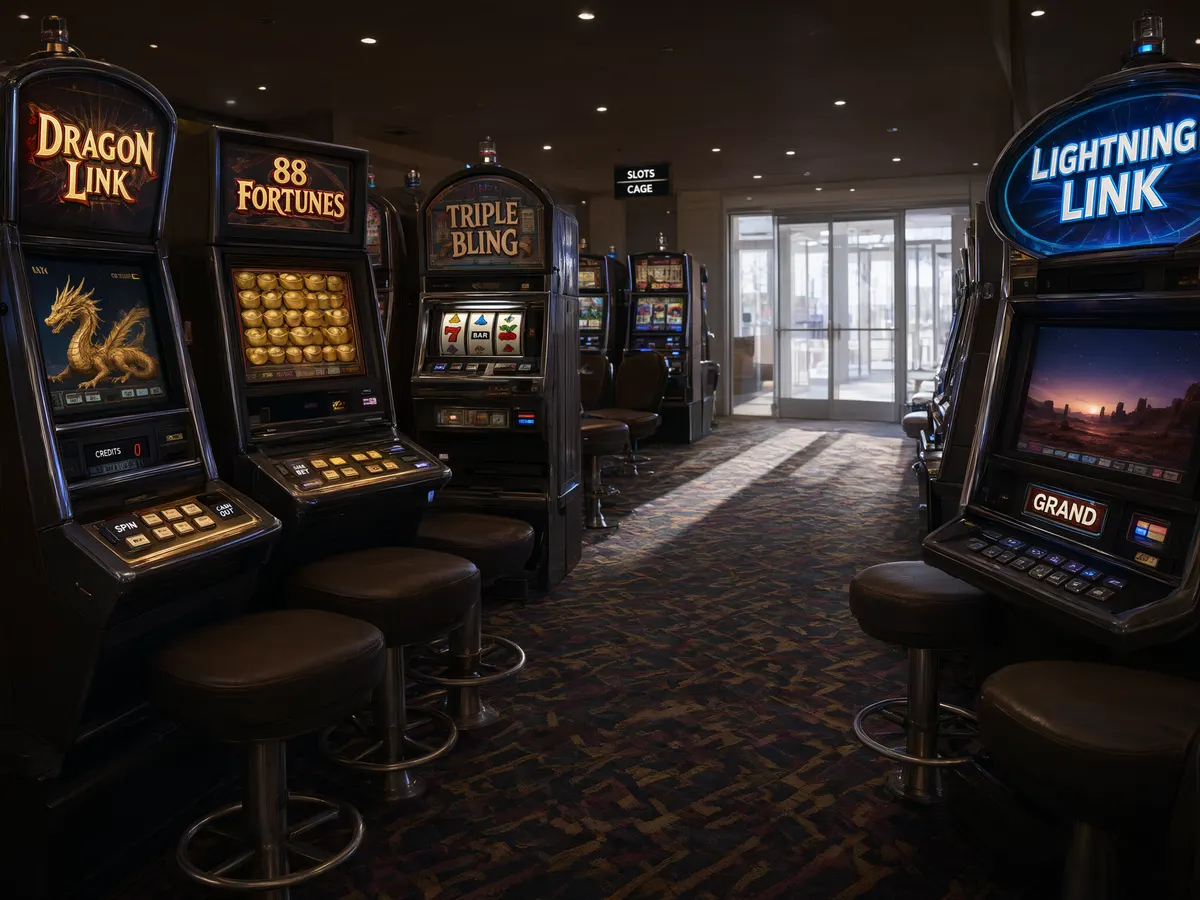
On the Strip, he said, operators get a new customer every 72 hours. Think about what that does to a slot floor. Your player is a tourist who may never return, has no loyalty history worth mining, and makes decisions based on what looks appealing on the walk from the lobby to the restaurant. Recognition matters. A licensed theme or a familiar cabinet silhouette does real work.
The locals market is the inverse. At Station Casinos, Boyd Gaming and Golden Entertainment properties, Jingoli noted, customers are in three to four times a week. Those players know the floor better than the shift manager. They notice when a bank of machines gets moved, they have opinions about which games have gone cold, and they exhaust a new title fast. Fresh product is not decoration there, it is retention.
Then there is the restricted market, the slot routes in taverns, convenience stores and grocery locations capped at 15 machines. Konami is heavily involved in it and Jingoli called it extremely competitive. He also said the economy has taken a toll on repeat visitation, with petrol and food prices feeding directly into how often a regular stops in. A neighbourhood tavern player making three trips a week instead of five is a measurable revenue problem for a route operator, and it travels straight up the chain to whoever leases them the machines.
| Segment | Who operates it | Visit pattern (per Jingoli) | What that tends to demand of a supplier |
|---|---|---|---|
| Las Vegas Strip | Major resort operators | A new customer roughly every 72 hours | Immediate visual appeal and recognisable brands; constant churn of first-time players |
| Locals casinos | Station Casinos, Boyd Gaming, Golden Entertainment | Three to four visits a week | Steady pipeline of new titles; games that survive heavy repeat play |
| Restricted locations | Taverns, convenience and grocery route operators | Repeat visitation, currently pressured by fuel and food costs | Small footprints, flexible terms, described as extremely competitive |
Three customer bases, one licence, one sales team. A manufacturer that only knows how to sell to the Strip is competing in about a third of Nevada.
The myth that the best game wins
Slot machine manufacturers like to talk about math models, hit frequency and cabinet engineering. Jingoli talked about capital expenditure.
Capex spend among Nevada licensees has slowed a little, he told the board, for the same economic reasons pressuring player visits. And here is the part suppliers rarely say out loud in a public hearing: “As a manufacturer, the onus is put on us to be as flexible and creative as we can to help the customer with getting new product on the floor.” Operators all want new product at some point. If the capex budget isn’t there, Konami’s job is to be a good partner, because those operators will be partners for a long time.
Translated, that means leases, participation deals, trade-in credits, staged payments, whatever gets the box installed. Jingoli said the company has done a good job being flexible with financing to get product onto casino floors. In a tight capex year, the competitive battle between konami gaming and its rivals is partly a financing competition. The game being brilliant is necessary and nowhere near sufficient.
The myth that a slow capex cycle means a bad market
You could read “capex has slowed” as a warning. Jingoli didn’t. “Overall, we are very happy with the market in Las Vegas and Nevada,” he said, and the numbers he brought along explain why the supplier business no longer lives or dies on cabinet sales alone.
Konami’s casino management system has gone from 40,000 connections four years ago to just under 160,000 this year, roughly a fourfold increase. A CMS handles player tracking, accounting, promotions and floor analytics. It is sold once, embedded for years, and expands device by device without requiring an operator to buy new machines. That is a different and stickier business from shipping steel, and it keeps growing while the floor refresh cycle stalls.
The myth players believe: that competition makes Nevada slots looser
Worth closing the loop on this, because the “most competitive market in the world” line gets repurposed quickly into a claim that Nevada machines pay better than anywhere else. Competition does shape floors. It affects which titles appear, how quickly dull games get pulled, and how hard operators work on comps, promotions and amenities, particularly in the locals segment where a disappointed regular can drive ten minutes to a rival.
What it doesn’t do is remove the house edge. Every gaming machine on a Nevada floor runs on an RNG, with a return to player percentage set within regulatory limits, and the inverse of that RTP is the operator’s long-run margin. A 94% RTP game carries a 6% house edge whether it sits on the Strip, in a Summerlin locals casino or in a tavern on Boulder Highway. RTP is a long-run average measured over millions of spins, not a session forecast, and volatility only changes how bumpy the ride feels on the way to the same math. Competition is a fight over which supplier’s games occupy the floor. It is not a fight over who gives money away.
Which is the quietly useful thing about Jingoli’s comments. The pressure he described, thin capex budgets, players counting petrol money, route operators squeezing on terms, is pressure on businesses whose revenue comes from that edge. If the people selling the machines are working this hard in the world’s most competitive gaming market, it is reasonably clear who the machines are built to favour. Set a budget before you sit down, treat the spend as entertainment cost, and use the deposit and session limits every licensed operator offers.