The number that matters in Renova Technology’s anniversary announcement is not 30. It is “same day”: a replacement unit ships from the same building that receives the broken one, while the de-installed device is diagnosed, repaired and put back on the shelf without ever changing vendors. That single-facility loop is the entire pitch behind Renova 360, the casino logistics technology and service platform the company launched as it entered its 30th year in business.
Everything else in the release is packaging around that idea. Whether it is worth paying attention to depends on how you think equipment actually fails on a gaming floor, and most of the common assumptions about that are wrong.
Myth: logistics is a cost centre, not a gaming industry innovation story
Downtime on commercial gaming equipment is a revenue line, not a maintenance line. Renova is explicit that Renova 360 is aimed at equipment with long product lifecycles, naming gaming and lottery systems alongside public safety and security technology, because in both cases an out-of-service unit costs something measurable every hour.
That reframing is the useful part. A slot cabinet, a cashless kiosk or a lottery terminal that sits dark is not a repair ticket, it is a position on the floor earning nothing while rent, staffing and compliance costs continue. The industry spends most of its innovation budget on the player-facing half of that equation and comparatively little on the question of how fast a dead box becomes a live one again. Renova is selling into that gap.
Myth: any repair depot can do this
The difference Renova is claiming is not repair capability, it is the removal of handoffs between vendors. In the conventional model, the spare comes from one inventory partner, the failed unit goes to a different repair house, warranty administration sits somewhere else again, and each transfer adds days plus a point where tracking breaks.
Renova CMO Louis Pine put it directly in the company’s statement: “Being able to pull a replacement off the shelf in the same facility that handles the RMA (return merchandise authorization) is a game changer.” He also framed the commercial logic behind it: “As manufacturers tighten their supply chains, they want partners closer to home with value-added capabilities.”
Read that second quote carefully, because it tells you what is really driving this product. This is nearshoring pressure translated into a service bundle. Manufacturers that spent years optimising for unit cost across long supply lines are now paying for proximity and consolidation instead, and casino supply chain tech vendors are repositioning to sell it.
What Renova 360 actually contains
Renova 360 is assembled from four service packages, configured per customer rather than sold as a fixed product. The split is worth reading closely, because the four packages address four genuinely different failure modes.
| Package | What it covers | Problem it addresses |
|---|---|---|
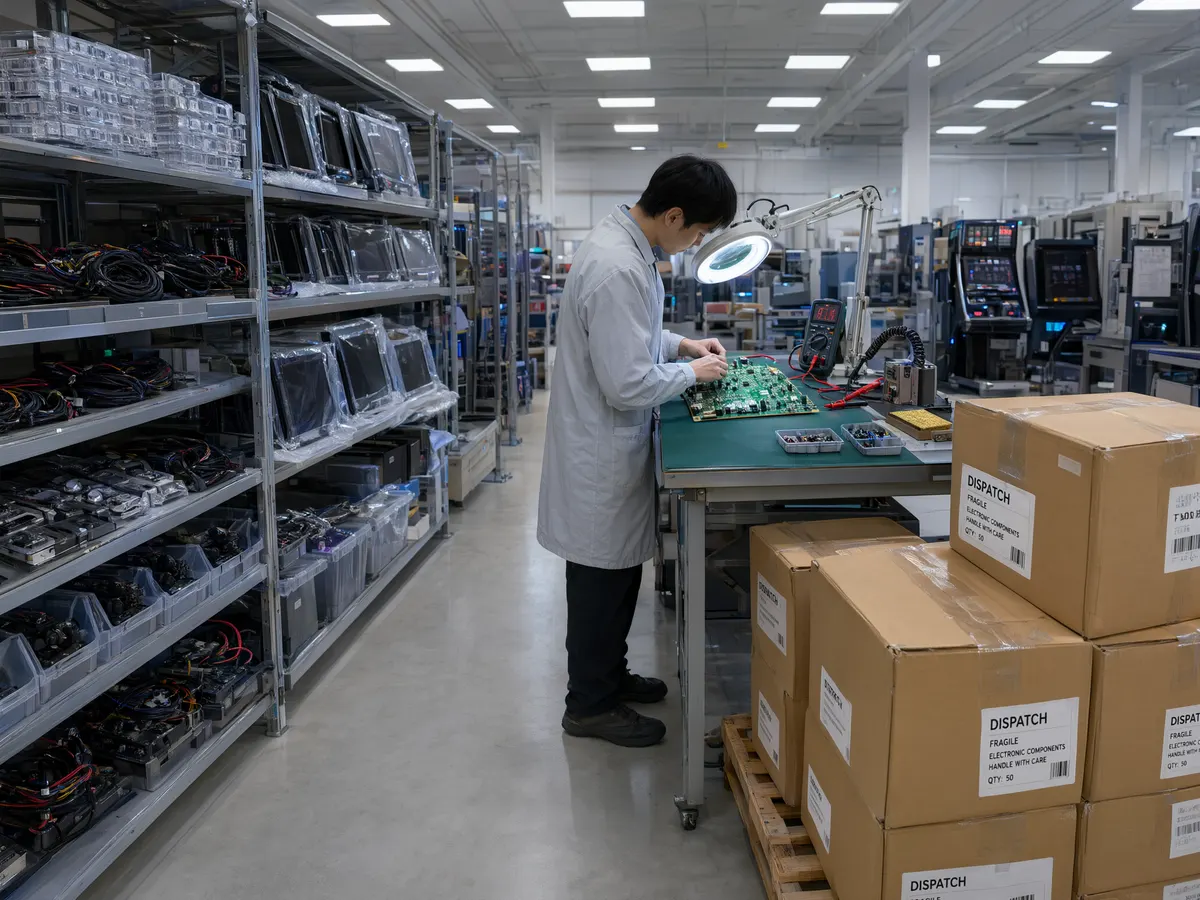
| Renova Repair | Depot repair and diagnostics, component-level PCB and PCBA repair, rework and ball-grid-array work, functional testing, failure analysis, repair data reporting | A unit has failed and the board is worth fixing rather than scrapping |
| Renova Reverse | Returns inspection, RMA and warranty management, advanced exchange, spare parts and replacement inventory, equipment tracking | Something must be swapped out in the field now and reconciled later |
| Renova Forward Logistics | Configure-to-order, kitting and light assembly, testing and quality control, order fulfilment, support for large-scale rollouts | New equipment has to arrive configured, tested and ready to install at scale |
| Renova Product Lifecycle Support | Inventory management including small parts and spares, refurbishment, end-of-life support, asset disposition and component recovery, storage | The platform is ageing and parts are no longer manufactured |
Alongside the launch, Renova says it has expanded its inventory-management programmes to better support configure-to-order, small parts management and same-day advanced exchange, which it describes as the current expectation rather than a premium.
Myth: this is casino operations software an operator can buy
It is not. Renova names its target buyers as OEMs and contract manufacturers, field service organisations, integrators and dealers, and enterprise technology teams. A casino does not purchase Renova 360; the manufacturer or integrator behind its cabinets, kiosks or terminals does.
That distinction matters for anyone trying to evaluate this from an operator’s seat. The benefit, if it materialises, arrives indirectly as shorter replacement cycles and better parts availability written into a supplier’s service commitments. If you want to know whether a logistics partnership like this is doing anything for your floor, the place to look is not the press release. It is the response times and spares guarantees in your existing service agreements, and whether they improve at renewal.
Where the standard procurement logic stops working
The conventional approach to equipment service is to tender the repair work to whoever quotes lowest per unit and hold a generous spares pool as insurance. On short-lifecycle hardware that logic holds. On gaming and lottery systems it breaks in two places.
First, the dominant cost is not the repair, it is the hours between failure and replacement, and the cheapest depot is rarely the fastest. Second, a large spares pool stops being insurance once the components reach end of life. Capital sits in inventory that depreciates while the specific board you need becomes unobtainable. Renova’s lifecycle package, with refurbishment, end-of-life support and component recovery, is pointed squarely at that second problem, and it is the part of the bundle least likely to be replicated by a generalist logistics provider.
Advanced exchange shifts the maths further. If a replacement ships the same day from stock, fewer spares need to be in transit or held locally at all. That is a real working-capital argument, though it trades inventory risk for dependence on one vendor’s shelf.
The founding detail that explains the whole company
Renova Technology was founded in 1996 to support one of the largest manufacturers of point-of-sale and self-service kiosk hardware. That origin sits close to the work it sells today: high-volume, long-lived hardware deployed in the field, where a failed unit has to be replaced quickly and the failed one has to go somewhere useful.
That is the thread worth following. Thirty years on, the company says the practice of tracking failures and feeding insights back to manufacturers still shapes every programme, and failure analysis with repair data reporting sits inside the Renova Repair package rather than being sold as an analytics add-on. For gaming hardware, where cabinets stay in service for years and a recurring board fault can quietly cost a manufacturer a fortune in warranty claims, structured failure data is arguably more valuable than the turnaround time everyone markets.
What the announcement does not establish
Renova describes a track record of year-over-year growth without publishing figures, and the launch arrives with no disclosed metrics at all: no average turnaround time, no uptime improvement, no named gaming or lottery customers, no pricing. Pine’s own quote references the company’s experience solving challenges over the last three decades, consistent with the 30th anniversary, but experience is not a metric, and anniversary announcements are marketing documents first.
So the honest reading is this. Consolidating repair, reverse logistics, forward logistics and lifecycle support under one roof is a coherent answer to a real problem, and the same-building exchange loop is a genuine structural advantage over multi-vendor chains. Whether it translates into measurably less downtime on a gaming floor is not something this launch proves, and it will not be proven by a press release. It will show up, or fail to, in the next round of service-level negotiations between manufacturers and the operators who carry the cost when a machine goes dark.