
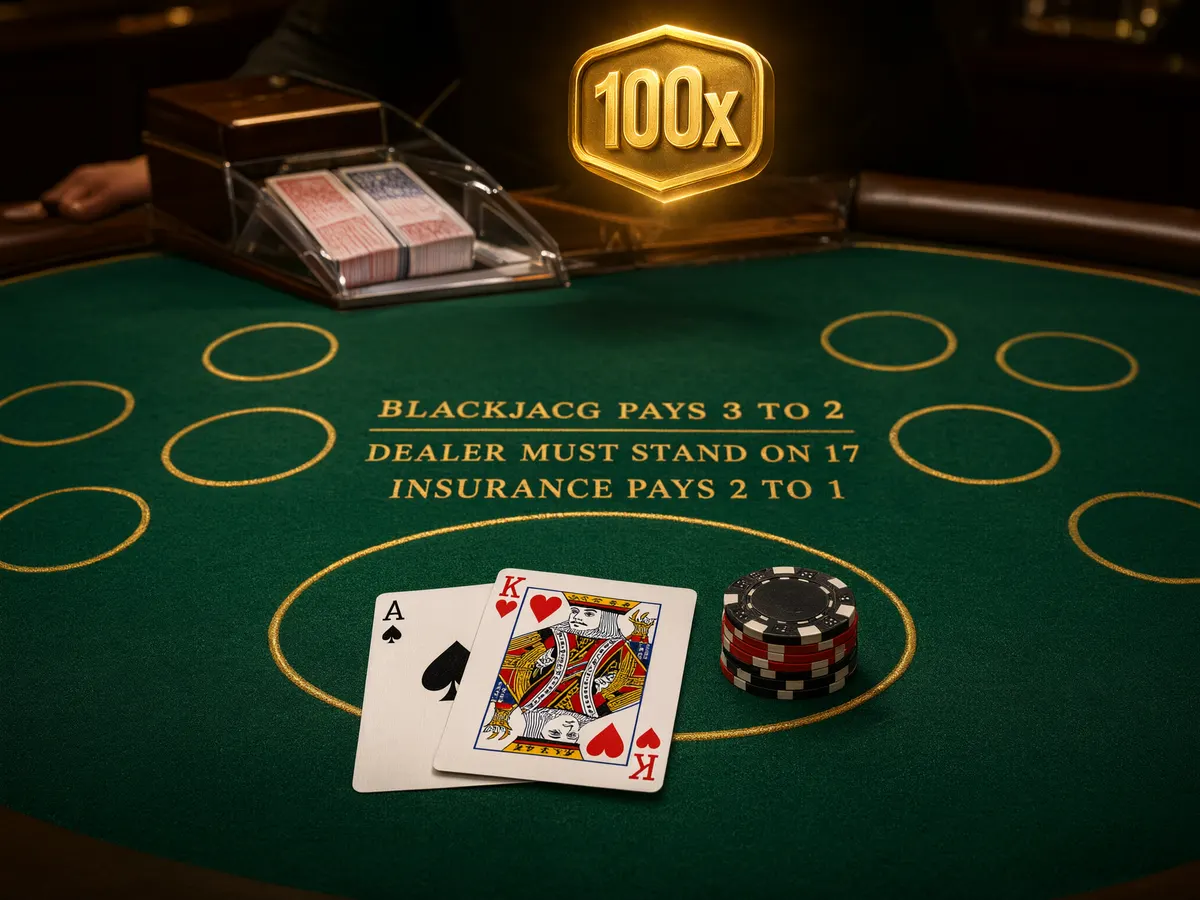
Would you pay an extra chip for a one-in-twenty-one shot at a hundred times your stake? That’s the question ICONIC21 is putting in front of live blackjack players with Blackjack Bonus Live, a new optional side bet on its seven-seat live dealer blackjack tables that reveals a random multiplier before a single card hits the felt, with a headline figure of up to 100x.
It’s a smart piece of game design, and it borrows a trick that has worked brilliantly in live casino game show formats. But the moment a number like 100x appears on a paytable, the maths deserves a careful look. Let’s walk through it the way you’d want a friend at the table to explain it.
What exactly is Blackjack Bonus Live?
It’s an optional side bet layered onto ICONIC21’s classic seven-seat live blackjack game. You place the extra wager before the deal. Once betting closes, the game reveals a randomly selected multiplier to everyone at the table. If your first two cards are a natural blackjack, an ace paired with any ten-value card, the side bet pays out at that multiplier.
Three details matter here:
- The multiplier is drawn before the cards. You know what you’re playing for, but not whether you’ll hit it. That’s the opposite of most slot-style multiplier mechanics, where the multiplier lands last.
- Everyone sees the same multiplier. It’s a table-wide reveal, not seat-by-seat, so all seven seats are chasing the same number on that round.
- Only a natural pays. Not a twenty-one made by hitting, not a five-card twenty-one. Ace plus ten-value in your opening two cards, nothing else.
ICONIC21’s chief product officer, Edvardas Sadovskis, framed the feature as a way to build anticipation around the natural blackjack, which is exactly what the pre-deal reveal does. When a 100x lands on the screen before the shoe moves, the whole table leans in. That’s the point.
How is this different from classic blackjack?
Mechanically, the main hand doesn’t change at all. You still get the same rules, the same dealer, the same decisions on hit, stand, double and split. A natural still pays its standard price on your main bet. The multiplier sits entirely on the side wager.
That separation is the thing to hold onto. Blackjack is unusual among casino games because the base game’s house edge is genuinely small when the rules are decent and you play correctly, often quoted in the region of half a percent. That edge comes from skill: you make decisions that affect the outcome. A side bet is a different animal. It’s a one-shot proposition bet with no decisions, no strategy and a fixed probability baked into the paytable.
So multiplier blackjack rules like these don’t make blackjack “better” or “worse” as a game. They bolt a lottery-style bet onto a skill game. Two separate wagers, two very different risk profiles, sharing one hand of cards.
How often does a natural blackjack actually land?
Roughly once every 21 hands. That tidy coincidence is why the number sticks in the memory, and it’s the single most important figure for understanding this side bet.
The probability depends slightly on how many decks are in the shoe. Here’s the pre-deal chance of your own two cards forming a natural:
| Decks in shoe | Chance of a natural | Roughly |
|---|---|---|
| 1 | 4.83% | 1 in 20.7 hands |
| 2 | 4.78% | 1 in 20.9 hands |
| 6 | 4.75% | 1 in 21.1 hands |
| 8 | 4.74% | 1 in 21.1 hands |
The arithmetic is simple enough to do on a napkin. With eight decks, there are 32 aces and 128 ten-value cards in 416. The chance of ace-then-ten is (32/416) × (128/415), and you double it because ten-then-ace works too. That gives about 4.74%.
Live tables typically deal from six or eight decks, so treat 4.75% as your working number. Put differently: across a session of 60 hands, you’d expect around three naturals. Sometimes five, sometimes none. Variance is brutal at these frequencies.
Does “up to 100x” mean what you think it means?
No, and this is where most players misread multiplier side bets. “Up to” describes the ceiling of a random draw, not the typical outcome. What determines whether the bet is reasonably priced is the average multiplier across thousands of reveals, weighted by how often each value appears.
Here’s the logic. If the side bet hits 4.75% of the time, and the payout is the multiplier applied to your stake, then the average multiplier needs to be around 21x just for the bet to break even. Anything below that is the house edge. And because the 100x reveal is presumably rare by design, the everyday multipliers have to be much lower to keep the long-run return where the provider wants it.
The table below is pure illustration using a 4.75% hit rate, not ICONIC21’s actual paytable, which hasn’t been published in detail. It shows how sensitive the return is to that average:
| Hypothetical average multiplier | Return per 1 unit staked | Implied house edge |
|---|---|---|
| 10x | 0.475 | 52.5% |
| 15x | 0.713 | 28.7% |
| 18x | 0.855 | 14.5% |
| 20x | 0.950 | 5.0% |
| 21.1x | 1.000 | 0% (break-even) |
Read that column on the right again. A difference of a few points in the average multiplier swings the house edge enormously. That’s why the published RTP in the game’s info panel matters far more than the 100x on the marketing banner. Check it before you bet, not after.
For context, established blackjack side bets like 21+3 and Perfect Pairs generally carry house edges many times larger than the base game’s, and the exact figure shifts with deck count and paytable. Multiplier-based side bet payouts follow the same rule: the bigger and flashier the top prize, the more of the return is concentrated in outcomes you’ll almost never see.
Should the multiplier change how you play the hand?
Not in any way that helps you. The side bet resolves on your first two cards, so by the time you’re deciding whether to hit or stand, it has already won or lost. A 100x reveal is no reason to double a twelve against a dealer ten.
This is worth saying plainly because excitement leaks. A table-wide multiplier reveal creates a mood, and moods push people into bets they wouldn’t otherwise make, both on the side wager and on the main hand. The dealer’s upcard still dictates correct play. The multiplier is noise as far as your hand decisions go.
One more thing the pre-deal reveal doesn’t give you: an edge from choosing when to bet. Because betting closes before the multiplier appears, you can’t wait for a big number and then jump in. If a game let you do that, it wouldn’t survive a week.
Why are providers building multipliers into live dealer blackjack?
Because the live casino game show format proved that a visible, escalating number keeps people watching. Crash games, multiplier wheels, lightning-style number boosts on roulette and baccarat, they all work on the same psychological lever: a large figure on screen that could be yours this round.
Classic blackjack is a quieter game. It’s deliberate, it rewards patience, and it doesn’t produce the big swings that make a stream clip shareable. Adding blackjack multipliers gives the table moments of spectacle without touching the core rules, which is a gentler approach than redesigning the game itself. For operators, the appeal is obvious: higher margin bets sitting alongside the lowest-margin game on the floor.
Expect more of this. ICONIC21’s launch lands in a market where nearly every live casino supplier is looking for ways to make table games feel event-driven, and natural blackjack is an obvious hook because it already carries a built-in sense of occasion.
What to check before you place the bet
If you want to try Blackjack Bonus Live, treat the side bet as paid entertainment rather than a route to profit, and look at four things first:
- The published RTP or house edge for the side bet specifically. It will be different from the main game’s. It’s usually in the game rules panel, not the lobby tile.
- The multiplier distribution, if it’s disclosed. How often does the top value actually appear? A paytable that lists frequencies is far more useful than one that only lists prizes.
- Minimum and maximum side bet limits. These often don’t scale with the main bet, and the cap can quietly limit what a 100x reveal is worth to you.
- Deck count and main-game rules. Six or eight decks, dealer hits or stands on soft 17, whether blackjack pays 3:2. These shape the game you’re actually playing for most of the session.
The honest summary: a multiplier side bet is a high variance bet with a bigger house edge than the blackjack hand it’s attached to. You’ll lose it around 95% of the time, and the rare wins are what the whole thing is built around. That can be genuinely fun at a stake you don’t mind losing. It is not a way to beat the house, and no sequence of reveals makes a natural more likely on the next deal, because each shuffle is independent.
Set a deposit or session limit before you sit down, keep the side bet small relative to your main stake, and use the operator’s reality-check and cool-off tools if a session starts running longer than you planned. If gambling stops feeling like entertainment, step away and contact a support service in your region.